*Sensitive information has been removed or redacted in accordance with non-disclosure agreements.
Snapshot
About: Leadership asked me to join a strategic task force with no formal research ask. I independently reframed the engagement, designing an AI-assisted research workflow to handle the scale, and collapsing three separate category problems into a single shared service model grounded in building clinician trust.
Role & scope: Owned discovery and problem framing, leading the research to uncover user needs and growth opportunities, while informing the strategic direction.
Team: Task force initiative; I led the research independently.
Timeframe: 2 Months
Key Decisions (type / authority):
Research direction- Owned
Problem framing- Owned
Synthesis approach- Owned
Strategic direction- Recommended
Problem
Brief I received: Leadership asked me to join a task force focused on an existing B2B clinical service that had become strategically important. The team had not framed a formal research ask, but early conversations made it clear they were approaching the opportunity too narrowly and risked moving forward with an incomplete view of the problem.
Reframed problem: The real problem was not how to optimize the existing service, but how to redesign the value exchange with clinics. Our current model assumed a level of trust and willingness to participate that did not match reality, while offering a fragmented set of touchpoints that served company goals more clearly than clinician needs. The deeper opportunity was to define a more coherent, omnichannel service model grounded in clinician trust and shared underlying needs across categories.
Design Process
Methods: Stakeholder interviews (3), Stakeholder Workshop, User interviews (25), Workflow design, AI-Assisted qualitative analysis
The service had been implemented separately across three product categories globally, with each operating independently. I suspected there was more overlap than the business was accounting for, so I set out to see whether there was a unifying model that could guide all three initiatives.
Design Rationale: The size of the research space and the tight deadline forced me to rethink my approach. I needed to deliver both depth and efficiency, so I designed an AI-assisted workflow.
What I built: I set up a ChatGPT assistant in our enterprise AI infrastructure to support qualitative analysis. I chose grounded theory because the method is well documented and aligned with how I work. I curated the knowledge base and designed a workflow with reporting checkpoints that I would review myself. That let me evaluate progress, catch errors, inspect the evidence more closely, and course-correct as needed.
Designed Core Artifacts: Code set, code hierarchy, uncertainty log for unclear observations, and synthesis outputs.
Designed Oversight Reports: Used the artifacts from the previous step to create reports that expose quality, coverage, consistency, and unresolved ambiguity.
Built the workflow:Structured the grounded-theory process so each stage produced or refined those artifacts
Inserted Checkpoints: Review the progress and outputs at key stages before continuing with analysis- with opportunities for course correction if needed.
Calbrated & Validated: I calibrated the assistant using mock interview data from our intern training program, keeping calibration content entirely separate from the live research
Analysis workflow
Transcript review: Read all transcripts without tagging or analysis to build baseline familiarity.
Open coding: Broke the evidence into meaningful snippets and coded each snippet according to its content. I usually lean toward more interpretive codes.
Reporting checkpoint: Reviewed the full set of generated codes for quality, coverage, and consistency.
Axial coding: Grouped codes into larger patterns.
Reporting checkpoint: Reviewed the tag hierarchy, user goals, needs, pain points, jobs to be done, journey types, and an uncertainty log.
Selective coding: Identified the central theme(s) driving the overall story.
Reporting checkpoint: reviewed the final synthesis for support, coherence, unresolved ambiguity, and fit with the broader structure. I would also trace themes back to direct quotes
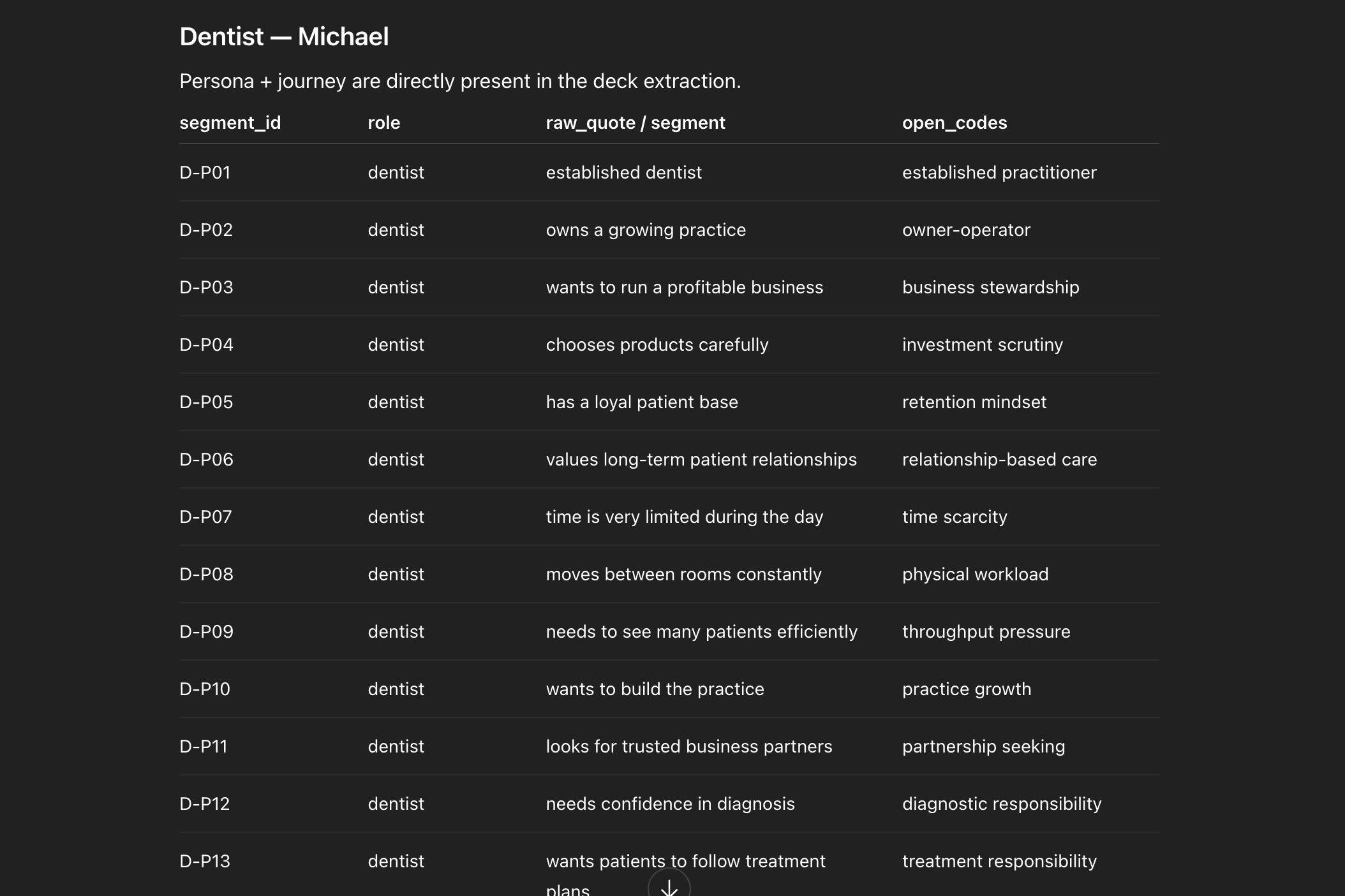
Open Coding: Raw Set of codes
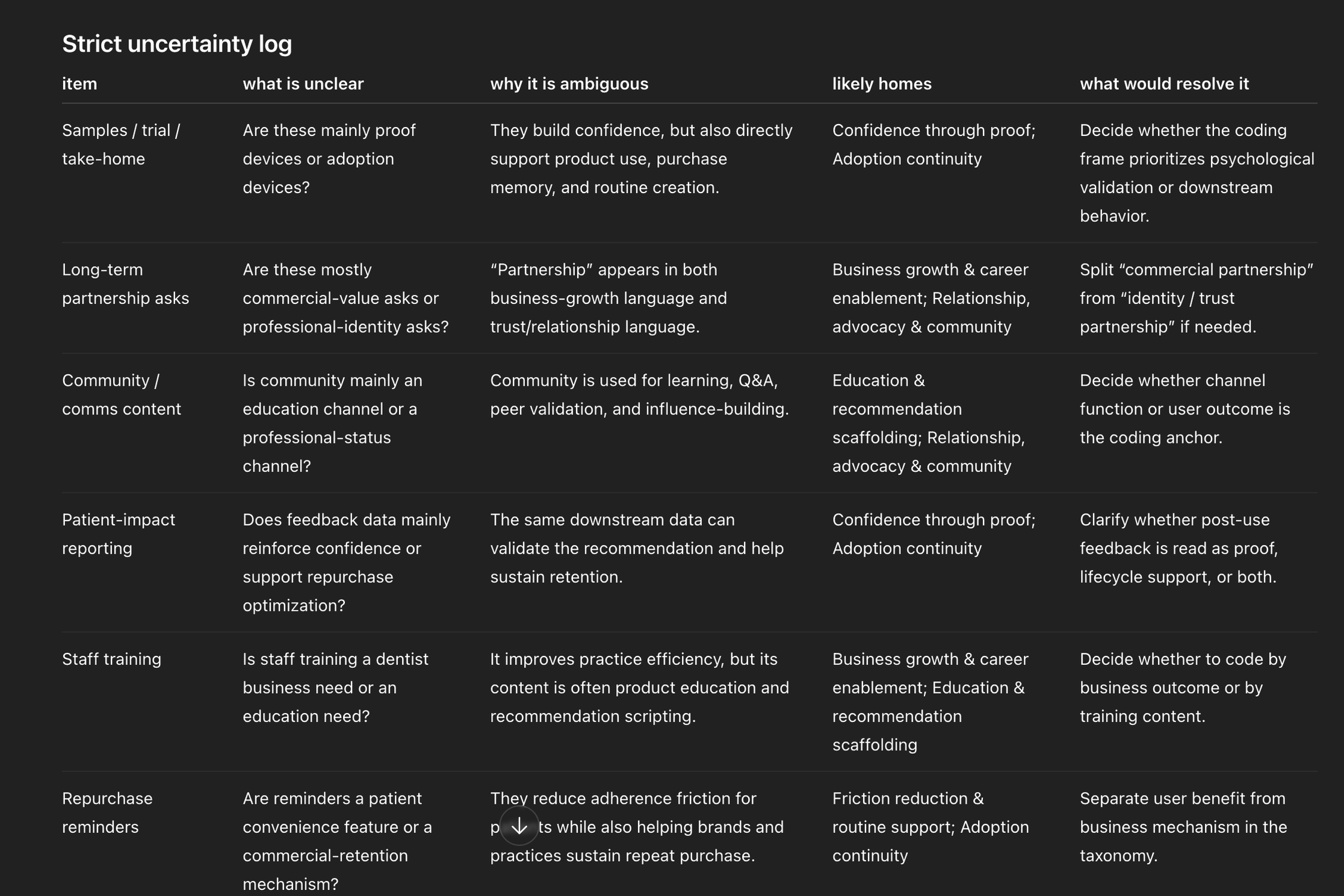
Uncertainty Log: Tracking open research questions, yet to be answered by the data.
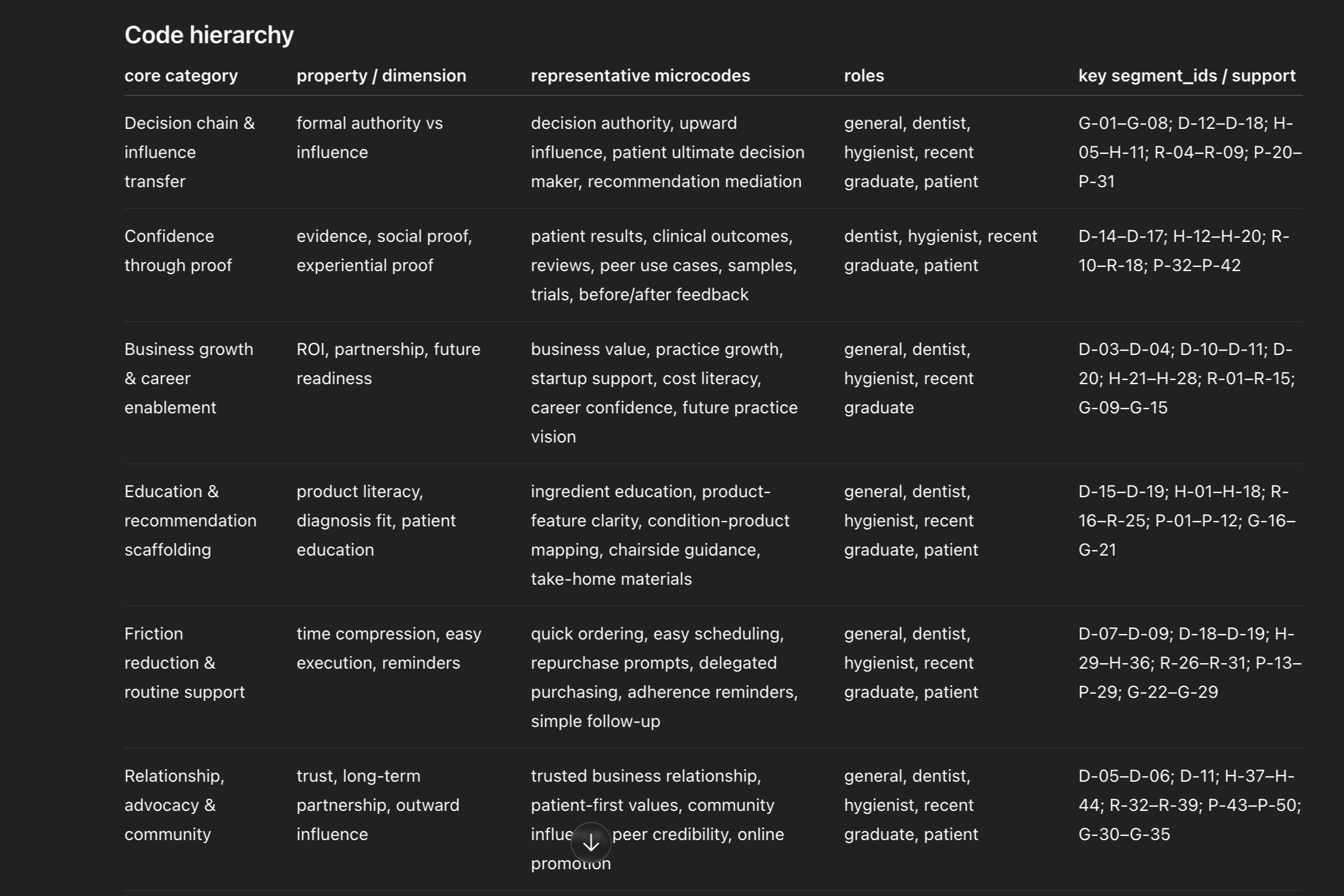
Axial Coding: Grouped codes by similarity
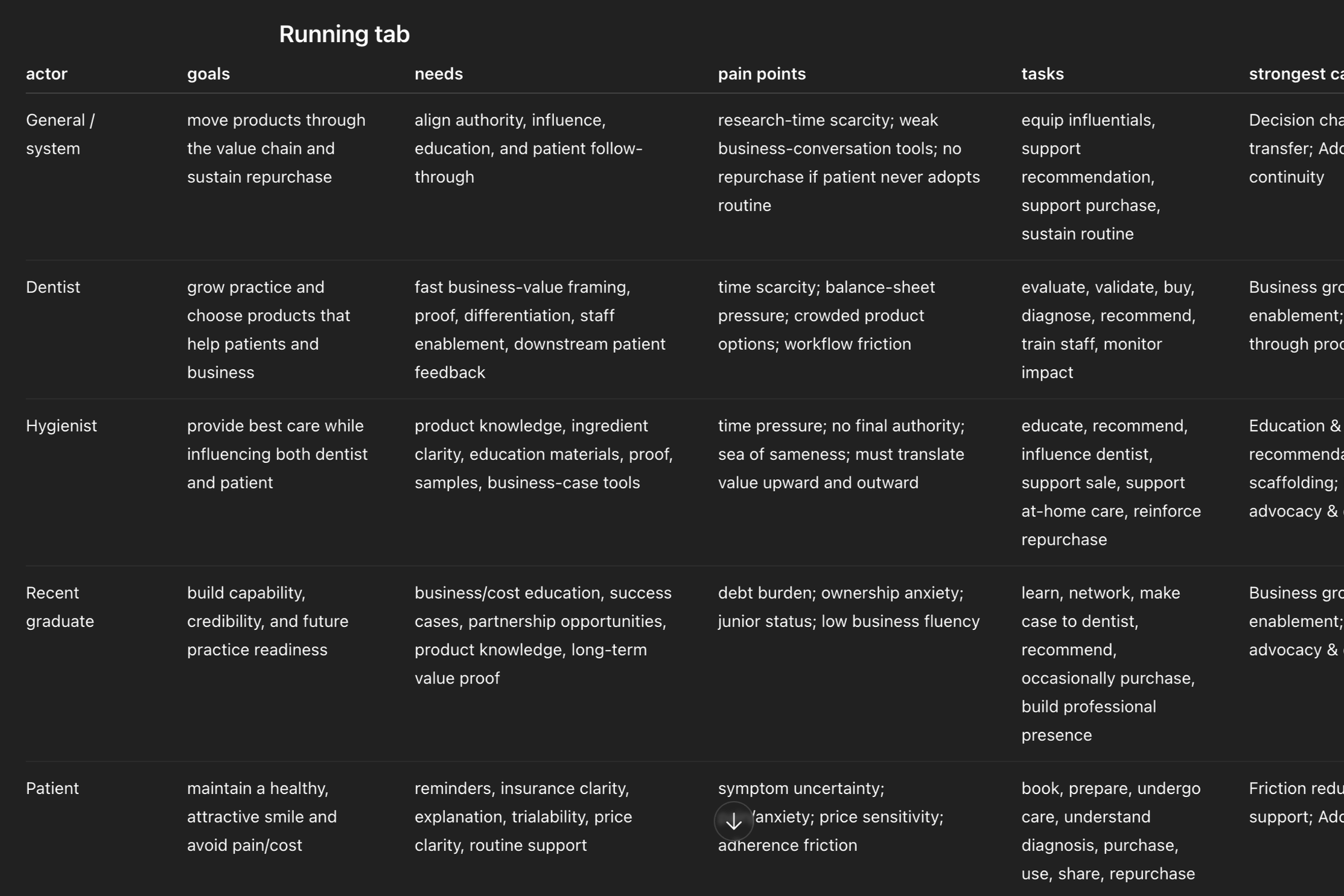
Custom Report: Tracking goals, needs, pain points, and tasks by role.
Artifacts: Experience maps, personas
Learnings 3-5 things that changed what we did
Business assumed a level of partnership they hadn’t earned: The business was operating under the belief that our limited service offerings were enough to become a broader clinical partner. We were helping with a few operational needs while expecting a level of access and trust that the current offering did not justify. And in some cases, we were not reliably delivering on the current value proposition.
Core user needs were overlooked
Patients dropped off after initial visits for a variety of reasons, creating a barrier to treatment completion. There was no clear way to get patients back in the treatment loop.
Clinical support staff were overlooked in favor of serving lead clinicians, even though a trained staff was key to carrying out a treatment plan successfully. Clinicians felt unsupported in their larger career journeys.
Corporate partnerships made clinics feel bought-off, or like salespeople, jeopardizing reputation among peers and patients
Experience was fragmented across touchpoints: Our disconnected services did not add up to a coherent brand experience. It felt scattered rather than intentional.
The problem was shared across categories: The business was treating this as three separate problems, when the same issues were repeating across product categories.
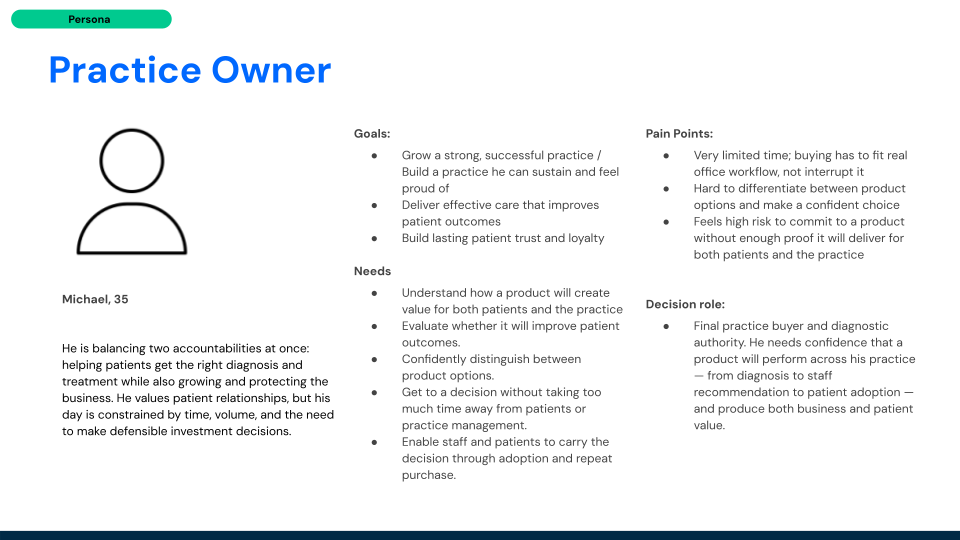
One of four personas
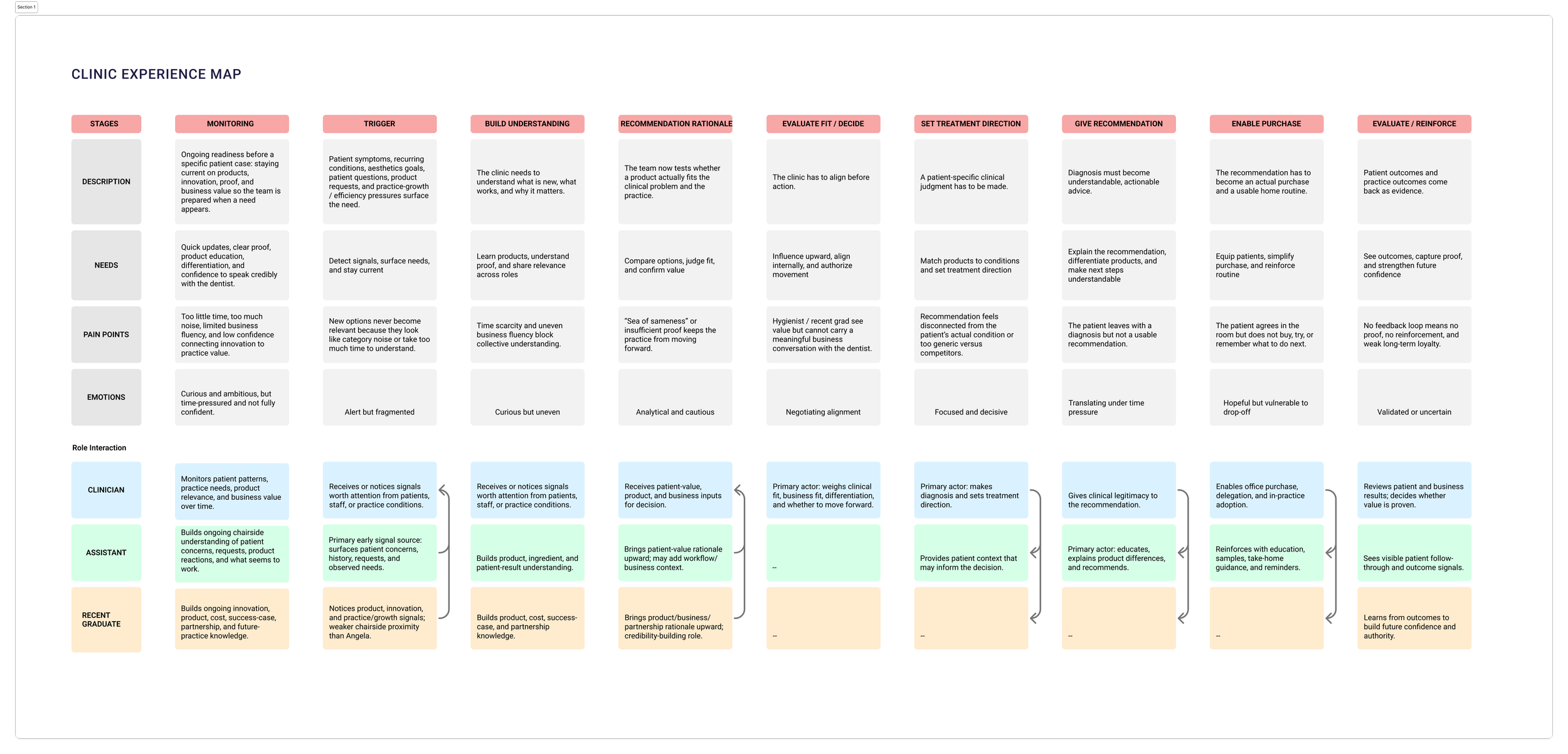
Experience map with swimlanes detailing interaction across clinical roles
Impact
Completed analysis in 5 hours compared to 84 hours manually- validated through manual analysis conducted after the AI-assisted workflow.
100% Code Coverage at selective coding level, compared to manual analysis.
3 category-specific problem spaces collapsed into 1 shared service model.